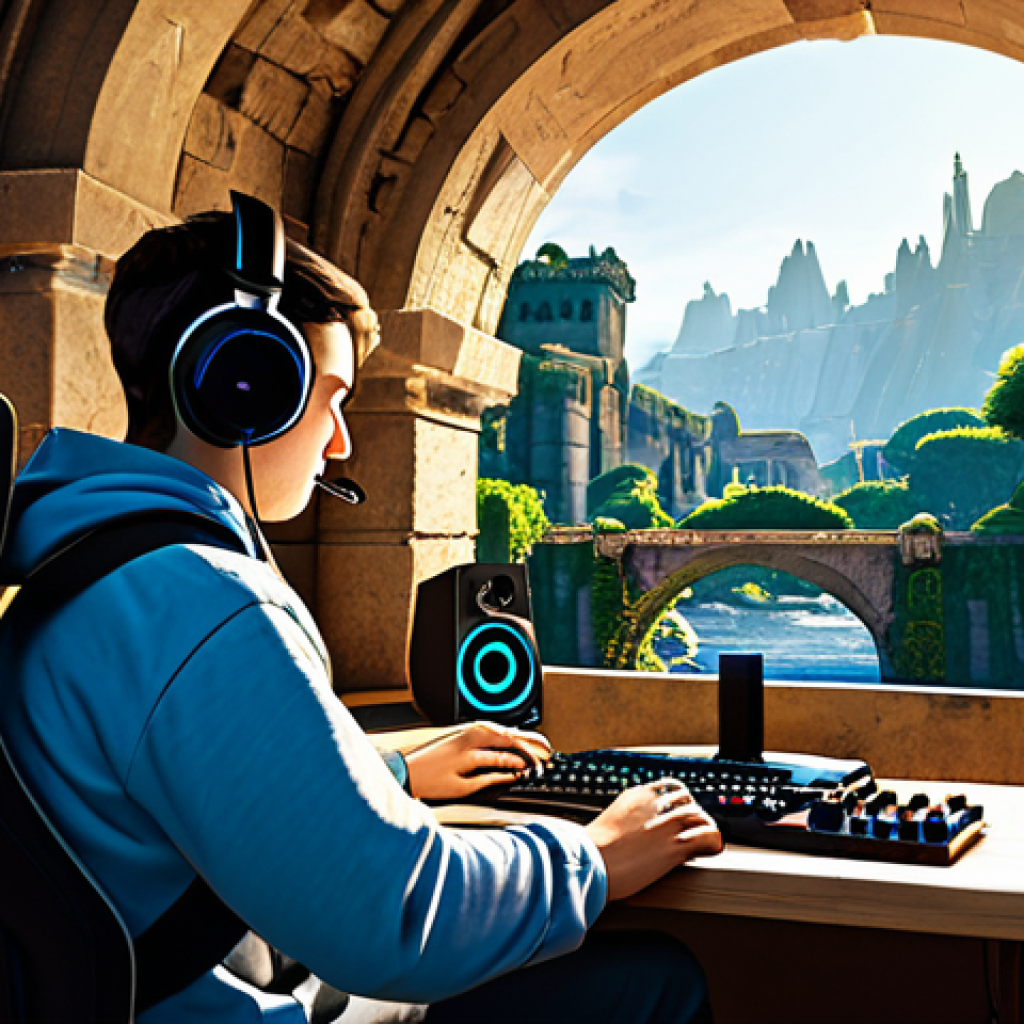
Stepping back into Aion, it’s not just the familiar landscapes or the thrilling PvP that truly pulls me in; it’s profoundly the atmospheric sound design.
I vividly recall those epic raid nights – the clashing swords, the vibrant spell effects, the booming boss music – all elevated by perfectly tuned audio.
What consistently amplified my personal experience wasn’t just the core game, but always custom-tuning those in-game music settings myself. It’s an incredibly subtle art, often overlooked by many players, yet absolutely vital for deep immersion, enhancing your focus, and even gaining a competitive edge, especially considering how crucial personalized audio has become in today’s evolving gaming landscape.
Adjusting those volume sliders and specific tracks isn’t just about turning down repetitive grind music; it’s about crafting *your* unique auditory experience, from the serene ambient whispers of Eltnen to the intense, strategic beats of a heated siege.
Let’s get into the specifics.
The Unsung Hero of Immersion: Diving Deeper into Aion’s Soundscapes
When you first log into Aion, it’s usually the stunning visuals that grab you. The sprawling landscapes of Poeta, the intricate architecture of Sanctum, or the sheer scale of the Abyss – they all scream epic. But what truly anchors me, what makes those moments of awe truly *stick*, is the sound. It’s the subtle rustle of leaves in the forests of Eltnen, the echoing footsteps in the deserted halls of Theobomos, or the distant, almost mournful cries of creatures in the dark corners of the Abyss. These aren’t just background noise; they’re vital threads woven into the fabric of the world, making it feel alive, palpable, and incredibly real. I remember countless times just stopping, not to admire the view, but to simply *listen*. That deep, resonating hum of a large Aetheric field, or the faint, almost imperceptible whisper of wind through ancient ruins – these are the auditory cues that truly pull you in, making you forget you’re sitting in front of a screen and transporting you entirely to Atreia. Without these ambient sounds, the world would feel hollow, like a beautiful painting missing its soul. It’s the difference between looking at a picture of a waterfall and actually hearing the thunderous roar and feeling the mist on your skin. That’s the power of Aion’s sound design when you let it fully envelop you. It’s a sensory experience that’s often overlooked in the chase for higher DPS or better gear, but it’s precisely these neglected layers that truly elevate a good game into an unforgettable journey.
The Subtle Art of Environmental Ambience
Think about it: have you ever truly paid attention to the distinct sounds of different zones? The gentle lapping of water in Reshanta, starkly contrasted by the harsh, metallic clang of instruments in Pandaemonium’s workshops. For me, these granular details are everything. They provide a sense of place that graphics alone can’t quite capture. I’ve often found myself using these environmental cues almost subconsciously. Running through a deserted area? The sudden sound of a twig snapping behind me immediately makes me whirl around, even if it’s just a harmless critter. Navigating a bustling city? The cacophony of vendor shouts, player spells, and NPC chatter adds to the vibrant chaos. It’s not just about what you hear, but what those sounds *communicate* about your surroundings. Over the years, I’ve developed an almost instinctual understanding of these sounds. The particular chime of a quest completion, the ominous growl of a powerful elite monster in the distance, or the distinct musical shift indicating a hidden quest objective nearby – these auditory breadcrumbs are invaluable for deep engagement. Tuning into them, really *listening*, transforms exploration from a simple task into an immersive journey. It’s a layer of depth that, once you start noticing it, becomes indispensable for truly feeling connected to Atreia.
Character-Centric Soundscapes and Feedback
Beyond the environment, your own character’s sounds are equally crucial. Every spell, every attack, every defensive shield has its own distinct auditory signature. When I’m playing my Cleric, the satisfying *thwack* of a Smite Judgement hitting an enemy, or the ethereal *whoosh* of a Benevolence spell washing over my party, provides immediate, tangible feedback. It’s not just a visual effect; it’s an audible confirmation of my actions. And this goes for enemy sounds too. Hearing the distinct charge-up sound of a Mob’s powerful attack, or the tell-tale *clink* of a rogue going into hide, can be the split-second difference between victory and defeat. I vividly recall a time in PvP where I was able to predict an Assassin’s ambush solely by the faint sound of their Stealth breaking near me – a sound that most players probably filter out as general background noise. But for me, it was a lifeline. It’s about personalizing that auditory feedback loop. If I can’t clearly distinguish my critical hits from normal attacks by sound, I feel less connected to my character’s performance. So, finding that sweet spot for your character’s ability sounds, making them stand out just enough without overwhelming the critical environmental or combat cues, is a crucial part of maximizing your personal Aion experience. It adds a whole new dimension to mastering your class.
From Chaos to Clarity: Strategizing with Audio Controls
In the thick of a massive Aion siege or a high-stakes PvP encounter, the sound can quickly devolve into an overwhelming wall of noise. Spells are flying, players are shouting, siege weapons are roaring, and sometimes, it feels like your ears are taking a beating worse than your character. This is where strategic audio customization doesn’t just improve immersion; it becomes a genuine competitive advantage. I’ve been in countless situations where recognizing a specific sound cue – the distinct ‘thunk’ of a Ranger’s arrow hitting me, the ‘shimmer’ of an Aethertech’s protective shield activating, or the unique ‘whoosh’ of a Sorcerer’s delayed explosion – allowed me to react milliseconds faster than I would have by relying on visual cues alone. The visual clutter in large-scale battles can be immense, but sound, when properly managed, can cut through that noise. It’s about filtering out the extraneous and amplifying the essential. My personal approach has always been to treat Aion’s audio mixer like a tactical command center, not just a volume knob. Every slider holds the potential to either drown you in unnecessary information or provide pinpoint accuracy for crucial moments. It’s a game of sensory optimization.
Prioritizing Combat Cues Over General Mayhem
For me, the default settings in Aion rarely cut it, especially in PvP. The first thing I do is drastically lower the “Background Music” and “Ambient” volumes, sometimes even muting them entirely during intense combat scenarios. Why? Because the dramatic background score, while great for solo questing, can actively obscure vital sounds like an enemy approaching from behind, or the tell-tale sound of a skill being channeled by an opponent. What I prioritize are “Effect” sounds – these are your spell effects, attack sounds, and crucial debuff/buff application sounds. I want these to be crisp, clear, and distinct. I once narrowly escaped a gank in the Abyss simply because I heard the faint, metallic scrape of a Templar’s Sprint skill activating behind a pillar before I saw them. That tiny auditory cue gave me just enough time to pop a shield and evade. It’s about training your ears to pick out those specific frequencies and patterns that scream “danger” or “opportunity.” It feels almost like developing a sixth sense for battle, purely through sound.
Voice Chat Integration and Positional Audio Awareness
Beyond the game’s internal sounds, effectively integrating voice chat (like Discord or TeamSpeak) with Aion’s audio is paramount for team play. Nothing is worse than not being able to hear your raid leader’s crucial instructions because the in-game boss music is too loud. I always make sure to use a good headset with clear audio separation and configure my voice chat software to duck (lower) the game volume slightly when someone speaks. Furthermore, Aion’s positional audio, while not as advanced as some modern titles, still offers critical spatial awareness. Understanding where a particular spell sound or an enemy’s footsteps are coming from can literally save your life. I’ve often used positional audio to track cloaked Assassins or find invisible Spiritmasters by the faint sounds of their minions. It’s a subtle skill, but it’s one that consistently gives me an edge, especially in tight corridor fights or when holding key chokepoints in sieges. Ignoring positional audio is like fighting with one eye closed; you’re missing half the picture.
Crafting Your Personal Aion Soundtrack: Beyond the Defaults
Let’s be honest, while Aion’s original score is undeniably epic, hearing the same battle themes loop for hours on end during a grind session can become… monotonous. This is where the true beauty of customizing your audio settings comes in – it’s not just about competitive advantage, but about enhancing your personal enjoyment and preventing auditory fatigue. For me, it transformed the game from something I just played into something I truly *experienced* on a deeper, more personal level. I’ve spent countless hours tweaking different music and ambient sound settings, essentially creating a bespoke soundtrack for my Aion journey. It’s an incredibly satisfying process, like being a DJ for your own gaming adventure. Sometimes, I want a serene, calming ambiance while gathering; other times, I crave high-octane orchestral pieces to accompany a dungeon run. The key is to understand what each slider controls and how they interact to sculpt your unique auditory landscape. It’s about personal well-being as much as it is about performance.
Tailoring Music for Every Mood and Activity
This is where the ‘Music’ slider becomes your best friend. For general questing and exploration, I often keep the music volume at a comfortable, low-to-mid level. It adds to the atmosphere without being overbearing. However, when I’m doing repetitive grind tasks, I sometimes mute the in-game music entirely and put on my own curated playlist of lo-fi beats or classical music. Why? Because it keeps my focus sharp and prevents the game’s default tracks from becoming a source of irritation. Conversely, for epic boss fights or high-stakes PvP, I might actually *increase* the game’s music volume to fully immerse myself in the intensity. The thundering drums and soaring orchestral pieces are designed to evoke emotion, and in those moments, I want to feel every ounce of that. It’s about being dynamic with your settings, not just setting them once and forgetting about them. Your Aion experience isn’t static, so your audio settings shouldn’t be either. I genuinely believe that this kind of mindful adjustment significantly contributes to long-term player retention and enjoyment.
Fine-Tuning Ambient Sounds for Maximum Immersion
The “Ambient” sound slider is, in my opinion, the most underrated setting in Aion. It controls everything from the chirping of crickets in a forest to the roaring winds in the Abyss. For me, these are the sounds that truly bring Atreia to life. I almost always keep this setting at a relatively high level, because it adds so much richness and depth to the world. Imagine soaring through the skies of Reshanta with only the game music playing – it feels empty. Now imagine it with the rushing sound of wind past your ears, the faint cries of unseen creatures below, and the distant echoes of battle. That’s the difference. During quiet moments, like sitting in a city or fishing, I love to just let the ambient sounds wash over me. It helps me relax and fully appreciate the artistry behind the game’s environment design. However, I sometimes lower it slightly during intense PvP to ensure critical combat sounds aren’t masked. It’s a delicate balance, and finding your personal sweet spot for ambient sounds is crucial for truly feeling connected to the world around you, whether you’re delving into a deep lore quest or simply enjoying the view from a high cliff.
Beyond the Sliders: Advanced Audio Tweaks and Their Impact
While Aion’s in-game audio options provide a good foundation, experienced players often realize that there’s more to sound customization than just moving sliders. True audio mastery sometimes involves delving into your system’s sound settings, understanding your hardware, and even considering external software. I’ve personally experimented with various sound enhancements, equalizer settings, and even different headsets to squeeze every last drop of auditory clarity and advantage from Aion. It’s a rabbit hole, for sure, but one that yields significant rewards in terms of both immersion and competitive edge. Think of it as overclocking your ears – pushing your setup to deliver the most precise and impactful audio possible. This isn’t just about making things louder; it’s about making them *clearer*, more *distinct*, and ultimately, more *useful* in your moment-to-moment gameplay. It’s the difference between hearing a general ‘thump’ and discerning the exact footfall of a heavily armored Templar from a nimble Assassin.
Leveraging Equalizer Settings for Positional Advantage
This is where things get a bit technical, but trust me, it’s worth it. Many gaming headsets come with their own software that includes an equalizer (EQ). An EQ allows you to boost or cut specific frequencies. For Aion, I’ve found that slightly boosting the mid-range frequencies (around 1kHz to 4kHz) can really make a difference for combat sounds. This is often where crucial spell casts, enemy movement, and player ability sounds reside. By doing this, you’re essentially making those critical sounds pop out from the background noise, almost like putting them under a microscope. I’ve noticed a significant improvement in my ability to pinpoint the location of enemies in the Abyss, or discern different spell types in a crowded siege. Conversely, I sometimes slightly reduce very low frequencies (bass) to avoid overwhelming booming sounds that can mask higher-frequency cues. It’s a subtle adjustment, but one that can sharpen your auditory senses significantly. It transforms raw audio data into actionable intel, which is invaluable in competitive play.
Optimizing Sound Drivers and Hardware Configuration
Never underestimate the impact of updated sound drivers! An outdated driver can lead to muffled audio, latency, or even complete sound dropouts – all things that will absolutely destroy your Aion experience. I make it a habit to check for updates for my audio drivers (whether it’s Realtek, NVIDIA, or dedicated sound card drivers) every few months. Furthermore, ensuring your Windows sound settings are optimized is crucial. Disable any unnecessary audio enhancements that might be enabled by default, like “Loudness Equalization” or “Virtual Surround Sound,” unless you specifically know they benefit your Aion experience. These can often introduce latency or distort critical sound cues. I prefer a “flat” or “gaming” preset on my headset and let Aion’s raw audio shine through. Also, consider the type of headset you’re using. Open-back headphones often provide a wider, more natural soundstage, which can be great for positional audio, though they do leak sound. Closed-back headphones offer better noise isolation, which is ideal if you play in a noisy environment. The right hardware, combined with optimized software, forms the bedrock of a truly superior audio experience in Aion. It’s a foundational step that many overlook but which truly unlocks audio clarity.
The Emotional Core of Aion: How Sound Shapes Your Experience
Beyond the tactical advantages and customization fun, Aion’s sound design, when properly appreciated, touches something deeper: our emotions. It’s a powerful, often subconscious, driver of how we perceive the game world, our characters, and even our fellow players. I’ve always felt that the best games don’t just provide mechanics; they evoke feelings. Aion does this masterfully through its auditory landscape, and by tuning into it, you amplify that emotional resonance. I still get goosebumps hearing the epic siege themes as the Balaureans charge, or feeling a sense of quiet dread as I delve into a dark, forgotten dungeon. It’s not just noise; it’s a narrative tool, a mood setter, and a memory trigger. The careful balance of triumphant scores, eerie ambiances, and impactful spell effects crafts an emotional rollercoaster that visuals alone simply cannot achieve. It’s about being truly *moved* by the experience, not just participating in it.
Nostalgia and the Power of Musical Memory
For veterans of Aion like myself, certain musical pieces instantly transport you back in time. The login screen music, the familiar themes of Sanctum or Pandaemonium – these aren’t just tunes; they’re capsules of memories. I vividly recall the first time I set foot in the Abyss, the ethereal, haunting music perfectly encapsulating the wonder and danger of that floating realm. Or the sense of dread and excitement every time the “Invading Legion” music started blaring, signaling an imminent PvP skirmish. By keeping these music volumes at a level where they can be appreciated, even subtly, you’re constantly reinforcing that connection to the game’s history and your own journey within it. It’s about allowing the game to tell its story not just through quests and lore, but through its rich, evocative melodies. These aren’t just arbitrary tracks; they were meticulously crafted to enhance the player’s emotional journey. It’s a powerful, albeit often unspoken, aspect of what makes Aion so compelling for so many of us who have spent years traversing Atreia.
The Soundtrack of Victory and Defeat
Think about the emotional impact of those critical moments in Aion – the exhilarating triumph of downing a powerful raid boss, or the crushing despair of losing a hard-fought siege. The game’s music plays a huge role in amplifying these feelings. The triumphant fanfare after a successful Dredgion run makes victory feel all the sweeter, a true celebration of your team’s effort. Conversely, the more somber or intense tracks during a losing battle can heighten the sense of urgency and desperation, pushing you to fight harder. I’ve often felt that the music perfectly mirrors my own emotional state during these high-stakes scenarios. It’s almost like the game is playing a personalized symphony for your triumphs and failures. Adjusting your settings to ensure these moments hit with their full intended impact means you’re not just playing a game; you’re living an epic saga. It’s an integral part of the narrative arc of your personal Daeva, giving weight and significance to every decision and every battle fought. This emotional tether is truly what keeps me coming back, year after year.
Troubleshooting Your Sound: Common Issues and Quick Fixes
Even with the most perfectly tuned settings, sometimes Aion’s audio can act up. From crackling sounds to complete silence, these issues can be incredibly frustrating and instantly break your immersion. I’ve definitely had my share of “why is there no sound?!” panic moments right before a critical raid. But the good news is, many common audio problems have relatively simple fixes. It often boils down to checking the basics, ensuring nothing is muted, and verifying your device outputs. Don’t let a minor glitch ruin your play session. Taking a few minutes to systematically troubleshoot can get you back into the game, fully immersed, in no time. It’s all about methodically ruling out potential culprits, which can save you a lot of headache and frustration in the long run. I’ve built up a mental checklist over the years, and it rarely fails me when sound issues pop up unexpectedly.
The Mute Button Conspiracy: Checking the Obvious
This might sound ridiculously simple, but you’d be surprised how often a lack of sound boils down to an accidental mute. First, check the obvious: Is your headset or speaker volume turned up? Is your operating system’s master volume unmuted? Is Aion specifically muted in your Windows Volume Mixer (right-click the speaker icon in your taskbar -> Open Sound settings -> App volume and device preferences)? I once spent 15 minutes troubleshooting Aion audio only to realize I had accidentally hit the mute button on my headset. The embarrassment was real, but the lesson learned was to always check the simplest explanations first. Also, double-check Aion’s in-game audio settings – ensure the master volume slider isn’t at zero, and that individual categories like “Music,” “Effect,” and “Ambient” aren’t muted. Sometimes, a patch or a driver update can reset these values, leading to unexpected silence. Trust me, it happens to the best of us, and a quick check of these basic settings often saves a lot of unnecessary panic.
Diagnosing Sound Latency and Crackling
Crackling audio or noticeable latency (where sounds are delayed) can be a real immersion killer. This often points to driver issues, conflicting software, or sometimes even hardware problems. My first go-to fix is always to update my audio drivers. If that doesn’t work, I try disabling any audio enhancements in my Windows sound settings, as mentioned earlier. Sometimes, background applications or even certain antivirus software can interfere with sound processing. Try closing unnecessary programs to see if the issue resolves. If you’re using a USB headset, try plugging it into a different USB port. For serious crackling, it might even be a sign of a failing headset or speaker cable, so test with another audio device if possible. Overheating components in your PC can also sometimes cause audio glitches, so ensure proper ventilation. These problems, while annoying, are usually solvable with a bit of systematic investigation. It’s about eliminating variables until you pinpoint the source of the disruption. Keeping your system clean and optimized helps prevent these issues from popping up in the first place, ensuring smooth, uninterrupted auditory bliss.
My Personal Audio Journey: Finding the Perfect Balance
My approach to Aion’s sound has evolved considerably over the years, from a naive beginner who just left everything at default to a meticulous tweaker constantly seeking the perfect auditory balance. It’s been a journey of trial and error, of countless hours spent in different zones and battles, patiently adjusting sliders until everything just *clicked*. What I’ve learned is that there’s no single “perfect” setting for everyone; it’s deeply personal, tied to your playstyle, your preferences, and even the nuances of your own hearing. But I can share the principles that guided my own audio evolution, and hopefully, they’ll inspire you to embark on your own. It’s about active listening, continuous refinement, and a willingness to experiment. My goal was always to enhance clarity in combat while maintaining enough ambient richness to keep the world feeling alive. This wasn’t a one-and-done process; it’s an ongoing dialogue with the game’s sound engine.
Evolving Priorities: PvP, PvE, and Everything In Between
Early in my Aion career, I focused almost entirely on PvE, so my audio settings prioritized environmental sounds and epic background music. I wanted to feel truly immersed in the story and the world. But as I delved deeper into PvP, especially large-scale sieges, my priorities shifted dramatically. Suddenly, I needed to hear every subtle skill activation from an enemy, every whisper of a cloaked Assassin. This meant drastically reducing background music and ambient noise during PvP-focused sessions, and boosting effect sounds to pinpoint accuracy. I literally have different audio profiles depending on what I’m doing in Aion. For a casual questing session, I’ll lean into the atmospheric music and ambient sounds. For a tense Abyss raid, it’s all about crisp combat cues and clear voice comms. This dynamic approach is what truly unlocks the full potential of Aion’s sound. It’s not about finding one ‘master setting,’ but rather creating a flexible system that adapts to your immediate needs. It’s like having a custom audio engineer always at your side, ready to adjust the mix for whatever challenges Atreia throws at you.
The Headset as an Extension of My Senses
Over the years, I’ve gone through several gaming headsets, each offering a slightly different sound profile, and I’ve learned that the right hardware is just as important as the software settings. A comfortable headset with good sound reproduction is an investment in your Aion experience. I personally prefer headsets with a balanced sound signature that don’t over-emphasize bass, as too much bass can muddy critical mid-range sounds. Features like virtual surround sound can be interesting, but I often find them less precise than natural stereo for pinpointing enemy locations in Aion. What truly matters to me is clarity and soundstage – the ability to discern where sounds are coming from. My current headset has become an almost invisible extension of my senses, delivering every crucial detail without distraction. It’s not just about hearing the game; it’s about *feeling* it, about reacting instinctively to every auditory cue. This synergy between my hardware and my meticulously crafted in-game settings is what truly elevates my Aion experience to something truly exceptional. Without it, I’d feel like I was missing out on half the game.
Mastering the Mix: A Guide to Aion’s Key Audio Sliders
Understanding what each audio slider in Aion’s settings actually controls is the first step towards personalizing your experience. It’s not just about turning things up or down randomly; it’s about making informed decisions to craft the perfect auditory environment for your playstyle. When I first started, I used to just haphazardly move these around, wondering why my game still sounded muddled during intense fights. But once I took the time to truly understand each category, it was a game-changer. This little table summarizes my typical recommendations for each slider, depending on whether you’re prioritizing immersive PvE or competitive PvP. Remember, these are starting points – your unique ears and preferences will guide the final adjustments. Think of it as a blueprint for your personal audio command center, allowing you to fine-tune every aspect of Atreia’s rich soundscape. Don’t be afraid to experiment! The beauty of these settings is that they are immediately adjustable, allowing for real-time feedback on your changes.
| Audio Category | Primary Purpose | My PvE/Questing Recommendation | My PvP/Raid Recommendation | Why I Set It That Way |
|---|---|---|---|---|
| Master Volume | Overall game volume | 70-80% | 80-90% | Controls global output; lower it slightly for balance, higher for combat focus. |
| Background Music | In-game soundtrack, themes | 60-70% | 10-20% (or 0%) | Enhances atmosphere in PvE; minimizes distraction for critical PvP sounds. |
| Effect Sound | Skill effects, attacks, environmental interactions | 80-90% | 100% | Crucial for combat feedback; prioritize these in all scenarios, especially PvP. |
| Ambient Sound | Environmental noises (wind, water, creatures) | 70-80% | 30-40% (or 0%) | Deepens world immersion; reduce to highlight combat effects in high-stakes play. |
| UI Sound | Menu clicks, system notifications | 50-60% | 50-60% | Provides essential feedback for UI interactions without being intrusive. |
| Voice Sound | NPC dialogue, character voices | 70-80% | 50-60% | Important for lore and quests; slightly lower in combat to prioritize player comms. |
Adapting Your Mix to Dynamic Situations
The table above offers a great baseline, but the true mark of a sound maestro in Aion is the ability to adapt your mix on the fly. I’ve often found myself quickly adjusting settings based on the situation. For instance, if my guild is struggling with a particular boss mechanic that has a subtle audio cue, I might temporarily mute everything *except* “Effect Sound” to ensure I hear it clearly. Or, if I’m just idling in a city waiting for a queue, I’ll boost the “Background Music” and “Ambient Sound” to soak in the atmosphere. This dynamic adjustment is often overlooked, but it can significantly enhance both your performance and your overall enjoyment. Many players set their audio once and forget it, but Aion is a dynamic world, and your audio settings should reflect that. Think of it like a sound engineer for a live concert; they’re constantly adjusting levels to ensure the audience gets the best experience. You can be that engineer for your own game. It’s an ongoing process of listening, tweaking, and refining, and it truly makes a difference in feeling connected to every ebb and flow of Atreia.
The Ripple Effect: How Audio Impacts Your Focus and Stamina
Beyond immediate gameplay benefits, optimizing your Aion audio can have a profound impact on your long-term focus and gaming stamina. Constant, overwhelming noise is tiring. It drains your mental energy, makes you less reactive, and can even contribute to physical fatigue. By carefully curating your soundscape, you’re not just improving your in-game performance; you’re creating a more comfortable, less fatiguing environment for your brain. I’ve noticed a significant difference in my ability to stay sharp during multi-hour siege conflicts or long raid nights when my audio is perfectly tuned. My ears aren’t ringing, my head isn’t pounding, and my focus remains razor-sharp. It’s about minimizing unnecessary sensory input and maximizing the clarity of crucial information. This isn’t just about fun; it’s about sustainable gaming. A well-tuned audio setup is an investment in your well-being as a player, allowing you to enjoy Atreia for longer, without the typical sensory overload that often comes with prolonged gaming sessions.
Closing Thoughts
As you can see, the sound in Aion is far more than just background noise; it’s a living, breathing component of Atreia itself. By taking the time to understand and customize your audio experience, you’re not just improving your gameplay – you’re unlocking a richer, deeper connection to the world, your character, and every epic moment within it.
Don’t let these crucial auditory layers go unnoticed. Invest a little time in mastering your mix, and I promise you, your Aion journey will never sound the same again.
Useful Information to Know
1. Always start by ensuring your primary audio output device (headset, speakers) is correctly selected in both your operating system and Aion’s in-game sound settings. A surprising number of issues stem from this simple oversight.
2. Consider investing in a quality gaming headset with clear sound reproduction and a decent microphone. This will significantly enhance your ability to discern subtle in-game cues and communicate effectively with your teammates.
3. Explore third-party voice chat applications like Discord or TeamSpeak. Properly configuring their overlay and volume ducking features can ensure clear communication during intense raids or PvP while still hearing game sounds.
4. Regularly check for and update your audio drivers (e.g., Realtek, NVIDIA, dedicated sound card). Outdated drivers are a common culprit for sound glitches, latency, and overall poor audio quality.
5. Don’t be afraid to experiment with your system’s equalizer settings, if available. Boosting or cutting specific frequencies can help highlight critical sounds (like spell effects or footsteps) and minimize less important ones.
Key Takeaways
Ultimately, mastering Aion’s soundscape is about much more than just hearing the game; it’s about leveraging every auditory cue to enhance your immersion, gain a competitive edge, and deepen your emotional connection to Atreia.
Personalizing your audio settings, from basic sliders to advanced EQ tweaks, transforms the game from a visual spectacle into a truly sensory journey.
Remember, sound is a powerful, often overlooked, tool in your Daeva’s arsenal – use it wisely to amplify every moment of your adventure.
Frequently Asked Questions (FAQ) 📖
Q: Aion’s default sound settings seem okay to me. Why should I even bother with all this personalized audio tuning? Isn’t it just a minor tweak?
A: Oh, my friend, that’s precisely what so many players miss out on, and honestly, it’s a huge shame! “Okay” is the enemy of “incredible” when it comes to immersion.
I used to think the same thing, just left everything at its default, but then one day, out of sheer boredom during a long grind, I started fiddling with the sliders.
And let me tell you, the difference was night and day. It’s not just a minor tweak; it’s like upgrading from a blurry old TV to a crisp 4K display for your ears.
The default settings are a generic baseline, designed to just function. But your ear, your playstyle, your preferences are unique. For me, muting that repetitive background music during intense PvP and cranking up the enemy spell effects?
It was an absolute revelation. Suddenly, I wasn’t just reacting to visual cues; I was feeling the fight, hearing the subtle tells of an incoming attack, and it made the entire experience so much richer and more engaging.
It’s about creating an experience that truly resonates with you, not just what some dev thought was generically fine.
Q: Okay, you’ve piqued my interest! So, if I want to dive into customizing my audio, where do I even begin? What’s your practical advice for someone who’s never really touched these settings before?
A: Awesome, you won’t regret it! It might feel a bit overwhelming at first, but think of it as sculpting. My personal starting point, and what I recommend, is to think about what distracts you and what helps you focus.
For instance, in Aion, that background music can be lovely for exploration, right? But when you’re in the heat of a siege, trying to coordinate with your legion, it can actually be a massive distraction.
So, my go-to move is to lower the “Music” slider significantly, almost all the way down, during any serious competitive content. Then, I crank up the “Effect” and “Ambient” sliders.
Why? Because those are where the crucial audio cues hide – the distinct sound of a Sorcerer casting a Meteor Strike, the rustle of a Stalker coming out of stealth, or the subtle thrum of an Aetheric Field forming.
Experiment! Play around in a quiet area, then jump into a battleground. You’ll quickly notice what sounds are important to your success and which ones are just noise.
Don’t be afraid to adjust mid-game; it’s an ongoing process, not a one-time set-and-forget deal.
Q: You mentioned gaining a “competitive edge” through audio tuning. How exactly does just adjusting sound levels help me win more in a game as complex and skill-based as
A: ion’s PvP? A3: This is where it really gets fascinating, and honestly, it’s a total game-changer once you get it. Think of it less as just “adjusting levels” and more as “optimizing your sensory input.” In a fast-paced PvP environment like Aion, every fraction of a second counts.
By turning down the non-essential sounds – like that beautiful but distracting zone music – you’re essentially decluttering your audio landscape. This allows your brain to immediately pick up on critical sound cues.
I can’t tell you how many times I’ve dodged a devastating Gladiator skill or spotted a hidden Assassin purely because I heard the unique “thunk” of their ability or the faint “whoosh” of their stealth breaking, even before my eyes registered them in the chaotic visual clutter.
It’s like having an early warning system. Being able to instantly identify an enemy’s class by the sound of their signature attack, or pinpoint their location based on environmental audio cues (like footsteps or spell impacts just around a corner), gives you precious milliseconds to react, counter, or position yourself advantageously.
It’s not about magic; it’s about minimizing sensory overload and amplifying the crucial information your ears provide, turning them into a powerful weapon in your arsenal.
📚 References
Wikipedia Encyclopedia
구글 검색 결과
구글 검색 결과
구글 검색 결과
구글 검색 결과
구글 검색 결과